is a dead Space Wolf.
No need to go into the vile details, but I have no love of the Space Wolves. Here’s hoping for a good nerfing in their new codex.
The terrain piece is Armor Cast based on plastic card with a few Mordheim bits.
is a dead Space Wolf.
No need to go into the vile details, but I have no love of the Space Wolves. Here’s hoping for a good nerfing in their new codex.
The terrain piece is Armor Cast based on plastic card with a few Mordheim bits.
Turns out a popular type of leaf ground cover is nothing more than filler in the birch tree seed pod. An article on the Reaper forums provides a summary of how to preserve and color the leaves. I was fortunate enough to find a cluster of these birch trees in a local park (apparently they are quite rare in the Chicago region). The time to harvest the seed pods is now; one week ago the pods were green on the branch, today the pods are dry and releasing on the wind – one good storm and the season will be over. To look for these trees in your area, look for the paper like bark on the trunk.
First efforts with the leaf litter return so-so results. The “leaves” are a bit big for scale & a little difficult to paint. Excuse the bright green, I need to find a better color for the next project. This example was painted after application – perhaps next time I’ll follow the recommendations on the Reaper forums and pre-color the leaves.
Terrain building is more fun with a constant stream of inspiring sources. Look outside the typical hobby forums for photographs (and photoshops) of real life.
Source: bpkelesy photo used without permission
Could this become a Hirst Castle on an ice peak? Why does our gaming terrain always have to be flat!
It does not take Photoshop to make something incredible, history is still in the world around us. Travel logs are rich in photos of castles, forts, churches and abbeys.
The world of architecture has plenty to offer:
Deviant Art is a constant source of images, both real and imagined. Search by Urban and Ruin for a world fit for any battle field.
Painting decay, rust and ruin can be difficult to master. Look to real examples to get the tone right at Smashing Magazine.
Source: daniel cheong photo used without permission
Finally, web design sites provide a plethora of textures. Look at steel, stone, marble, rust and bone for real world color.
Table Top World is a new resin terrain company creating fantasy buildings. Not only do they have 3 three very nice kits to launch their web store, but their build style is completely unique. When creating a stone effect, they literally use stone to create the model. Read all about the method in this interview with the owners/sculptors on Cianty’s Tabletop Wargames. Additional images posted to photobucket.
Took about 10 weeks of hard work, but I’m rather satisfied with the result. In the end, the 8×4 table was consolidated into a tightly packed 4×4 table – perfect for a skirmish game like Legend of the High Seas. The event organizer was please with the terrain & apparently the castle was a hit with the players.
Looking at the finished project, I would to add a few taller pieces. The jungle plants are nearly as tall as the castle structures – I’d like for the castle to break through the forest canopy. Guess that’s a project for next year.
Adepticon is almost here & the castle is nearly finished. For this project, I’ve spent a lot of time painting with a sponge. Its a great little tool which completely eliminates any brush marks. With the highly textured surface of the Hirst blocks, the sponge quickly applies paint to the surface & leaves shading in the crevices unmarked. Wet blending is a snap – the sponge easily blends from color to color.
All that is left is a bit of static grass on the bases and creeper lines on the walls with flock.
Paint List
Field Stone:
Chipped Stone:
Soil:
The pirate castle for Adepticon is finally coming together (and with 2.5 weeks to go – it better!). 25 pieces cover a 6 foot by 2.5 foot table space. When combined with jungle plants, the whole set up should fill a 8×4 gaming table. I have a lot of painting to do, but a big brush should cover a lot of ground in a hurry.
The castle layout begins with the two large round towers with the gate house ruins in between. Next is the open court, presently occupied by pirate booty in the form of wine barrels. Past the loot is the armory on the left and to the right, the chapel. Next comes the remains of the grand hall, now little more than an entrance way & a few pillars. Finally, the oldest part of the castle stands with a watch tower on the left and the corner keep on the right. The broken remains of the walls surround the fort.
Both towers below have full floors at the 4 inch level, making them fully 3D gaming pieces. The ground cover is Hirst Arts Cavern Accessory Mold #85, wooden craft barrels and resin cannon balls.
It is an old concept, but damn if plastic plants don’t make for super easy terrain. Take a trip out to Michael’s or Hobby Lobby stock up on:
After a few nights work, you’ll have a jungle worth of terrain to cover the gaming table. I’ve never been a fan of hot glue, but the product does a fine job of holding everything in place. 25 stands/150 glue points and I’ve had to re-glue one plant frond.
Look for this jungle to be part of the ruined pirate castle playing at Adepticon 09.
The alien has arrived & its hungry. Prepare to be infested!
5th edition 40K brings strict line of sight to the terrain rules. The solution is area terrain with defined places for all objects. A 1/4 MDF board is drilled with sockets for 60mm and 40mm wooden disks. Look for this terrain system at the upcoming Adepticon convention.
For these two terrain sets, each disk holds a mini-diorama built from Hirst Arts blocks, PVC pipe, a plastic Easter egg and lots of Terrain Putty (light tan) & Apoxie Sculpt (light gray) epoxy putty. In addition to standard sand flocking, the MDF board is also coated with a mix of play sand applied wet & saturated with white glue. The ridges represent underground tentacle growth from the infestation, hopefully the effect will be more noticeable once painted.
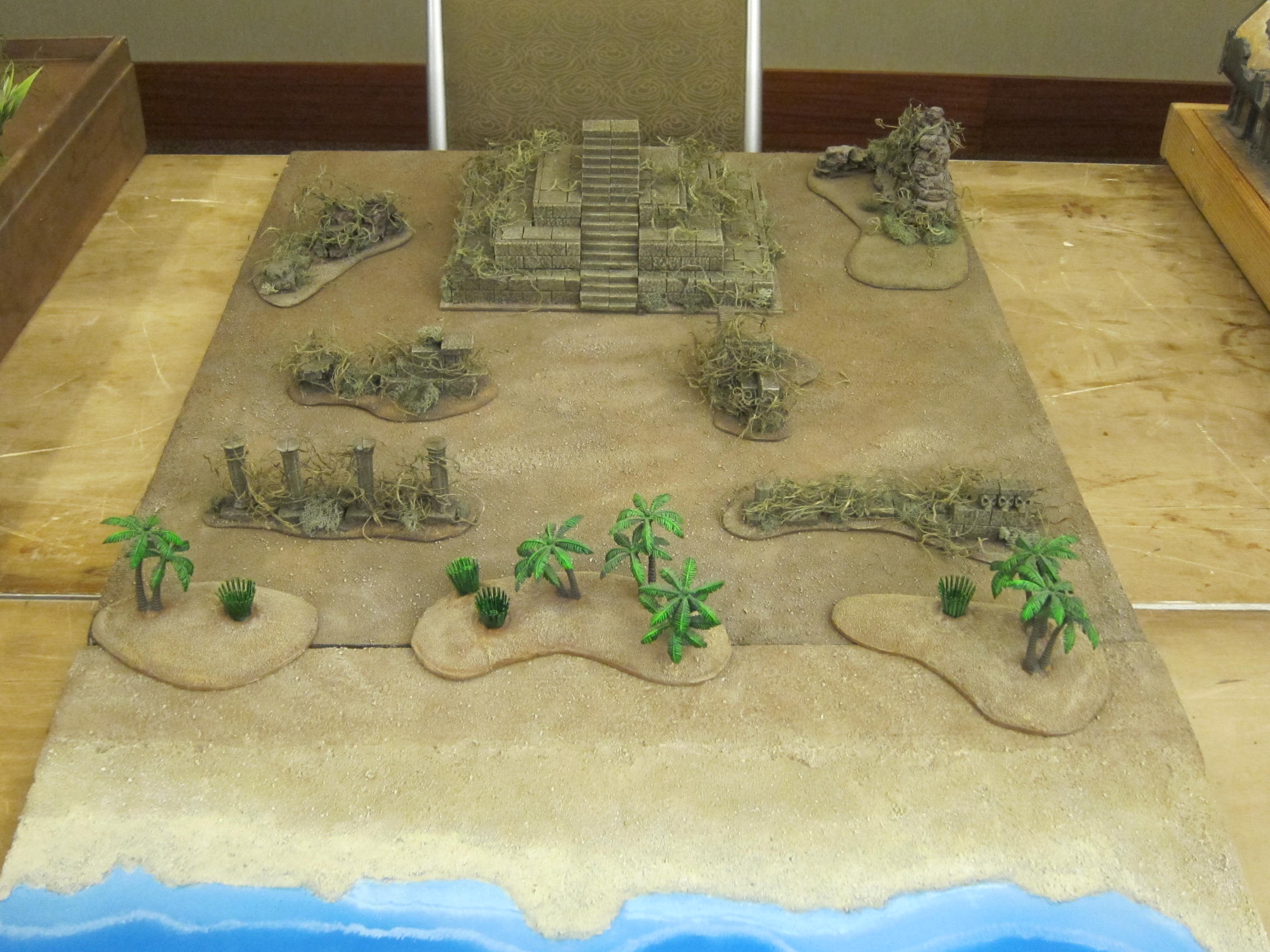
First installment in a rather large project for Adepticon: a ruined pirate castle. The table will be used for the group Legend of the High Seas game on Friday and Saturday night. Plans for the rest of the castle include a second round tower, one or more square towers, a fallen main hall, a few grand facade and lots of jungle foliage.
The ruined tower is built from Hirst blocks with a floor tile carve as the second floor and wall paper texturing the base. The open side and missing upper floors represent the damage done to the fort when sacked by the British navy – but in reality are a nod to playability, giving easy access to the structure.
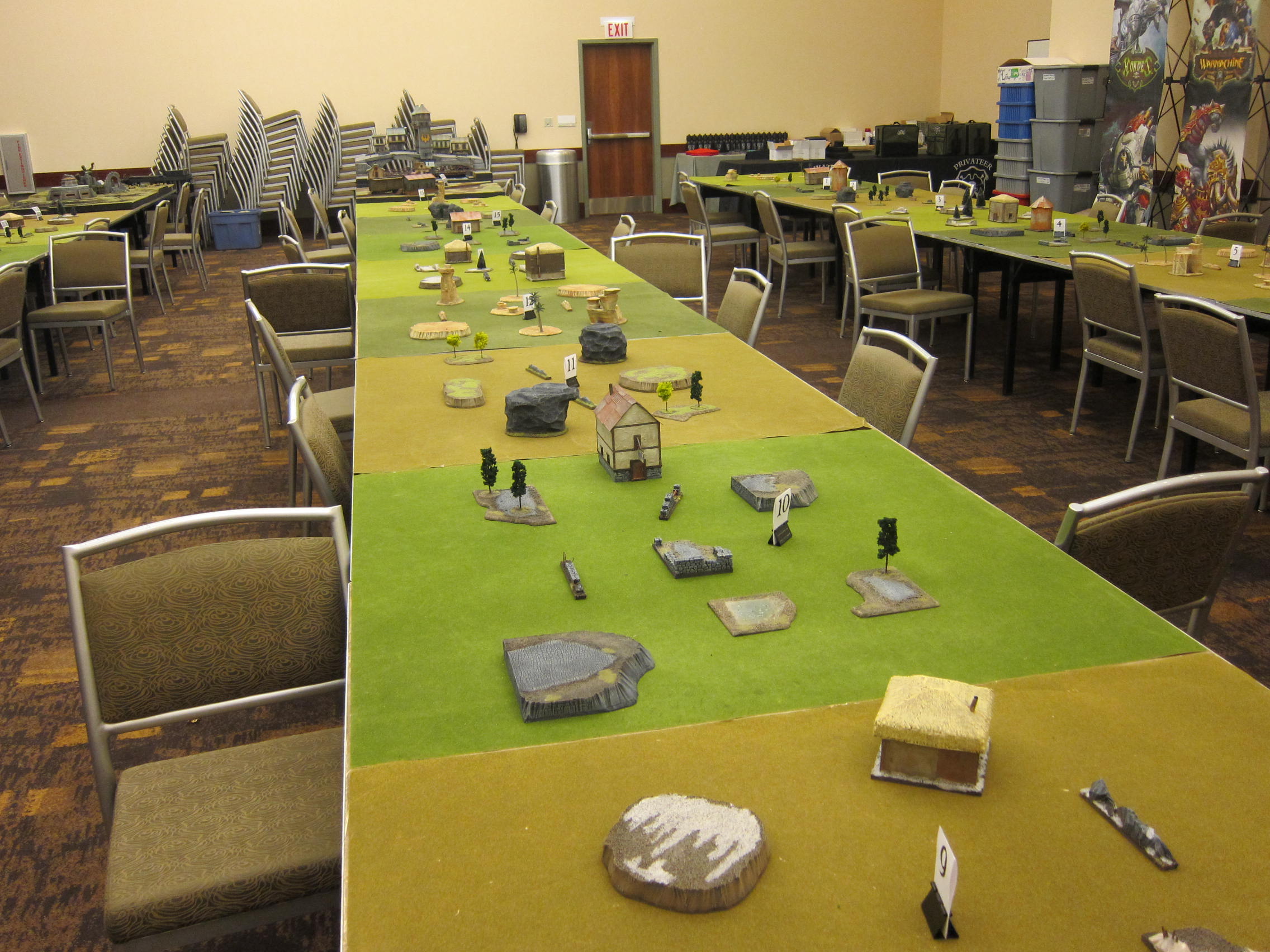
The 5th ed 40K rules put a new spin on terrain building. LOS now strictly governs what a model can see. Area terrain, the abstract fuzzy space of trees or ruins on a platter, is gone. The solution adopted by Adepticon is to place all terrain objects on 3 inch disks with matching sockets in a MDF base. The Hirst Arts Pipe molds, along with the Sci Fi molds, provide an excellent resource to build all the required objects.
Pumping station made from 5/8 Pipe mold, 3/8 Pipe Mold, Station Builder, Star Ship Wall mold and the Star Ship Deck mold.
From the Warp is sponsoring a best base contest. Getting motivated was a bit of a problem until I needed a proof of concept test for a pot topper.
What’s a pot topper? It is a 6 inch disk of static grass used with silk flower arrangements that can also be cannibalized for miniature ground cover. Look for pot toppers at Michaels Arts and Crafts – mine cost $1.99. Opening the topper took a sharp scissors and a bit of patience. The static grass sheet is stiff and full of texture. When cut apart, the clumps are between 4 & 6 mm tall. At this point, I’m not certain if they are any improvement over loose static grass, but I see great potential for the grass on larger projects such as terrain. In any case, the clumps are a much cheaper alternative to Silfor.
The rest of the base is made from more conventional materials: a bit of bark for the stone & field grass for the tall plant spikes. Painting is a simple combination of dry brush and wash. The whole project took about 2 nights of puttering around time in front of the TV.
Okko is a two player game of samurai warriors based on the comic by the same name. Published as board game with paper figures, the game was originally intended to be played with pewter miniatures. YIU (who did such an excellent job with the Alkemy jungle board) created a set of terrain features to support the 3D aspect of the game.
The French language Okko forums contain two WIP threads: tower and compound. Additional notes in English at the Wyrd forum. Check out the Fortin and Okko galleries on Photobucket or the unofficial Okko blog.

A handy trick to create rocky ground using a heat gun over insulation foam. Finished effects shown above in the display bases.
A wonderful new batch of terrain created by Marcin for Adepticon 09. He has a great eye for detail – perfectly straight plastic card, more rivets than I care to count and no fear of departing from a box design. The fantasy pieces pleasantly incorporate GW plastic kits and show off some putty work. Check out the thread on Cool Mini forums for even more pics. While there, be sure to review Marcin’s collected works.
The first rule of resin casting is to keep moisture away from the resin. Any contamination & the resin will bubble and will create a flawed casting. But what happens if water is deliberately introduced to the resin? Will resin form huge bubbles? Will the resin geyser like Coke with Mentos?
The experiment mixed 1 part water with 2 parts resin. The heavier resin floated to the bottom of the container & resisted mixing with the water. Only after the excess water was drained from the container did the resin begin to set up. I was disappointed that the resin/water mix only created a substance some thing like oatmeal. No 10x expansion in volume. No flowing river of bubbly resin. Looks like I need a Plan B to make my toxic chemical soup.
The rest of the project is part of a terrain building surge for Adepticon. The project will mix the Hirst Arts Pipe molds with Imex plastic kits and a bit of kitchen garbage including water bottles & soup cans. The resin does serve one purpose – the fragile plastic bottle is now supported by the internal coat of resin.
For my daughter’s 3rd birth day we threw her a pirate themed party – and that required a pirate flag. The skull and crossbones shape is a hand drawn stencil applied to a standard black plastic tablecloth using doubled sided Scotch tape. The spray paint took well to the plastic sheet, bleed thru was minor around the stencile, over spray was moderate (windy day) and the double stick tape holding the stencil easily pulled off with the paper.
As a gaming aid, I can see a lot of uses for table mats created using this method. Imperial Eagles, cammo patterns, cobble stone streets – just about anything could be cut into a stencil and sprayed onto a plastic sheet. Don’t feel like making your own – check out Litko’s selection of pre-made stencils.
Spectre Hobbies was good enough to provide a Master Class Scenery & Basing Kit for review here at Chicago Terrain Factory. The package includes 4 seasons of turf & static grass, long strand field grass, snow cover, assorted cork, wood chips, white glue, water effect, sand, Texture Paste – White, Mineral Texture Gel and a few supporting items such as bases and stir sticks. The kit retails for $21.99 and is a quick and affordable way to stock up a modeling collection.
My favorite components of the basing kit are the two jars of paste. The Texture Paste is a creamy white material which applies sort of like shaving cream. Mineral Texture Gel contains sand and does a fine job of adding grit to the base of a model. Use either to cover slota base holes or to provide dry brush ready texture. The Mineral Gel dries solid, but retains an elastic property – I found this the hard way when trying to cut holes for field grass. Once my jars run dry, I’ll be looking to restock from Spectre.
Weighing in at .2 oz, the bags of turf and static grass are more than enough for an army sized basing project. When finishing my Pirate project, I based 19 figures using both turf & flock and barely put a dent in the amount supplied. The color range is similar to ground covers sold by Woodland Scenics, adding the stronger colors sold by Noch would be a nice upgrade to this kit.
I’m not sold 100% on cork as a rock substitute – it always seems to look a bit “corky”, but look at the example base to decide for yourself. Rather than supplying three types of cork, the kit might better supply single sheets with instructions to rip into rocks. I used one of the flat sheets on the base above and quickly began to generate my own cork rocks.
The one part water effect provides a high gloss finish to an already textured surface (see Texture Paste above). I’d rather have seen a 2 part kit included that is able to create a 3D water effect.
The field grass packages are much too small – creating 4 plugs for the pirate bases used up half of supplied grass.
The wood chips for use as slate are much too big. Of the two pieces, the smallest covers a 30mm base and the largest is better used on a CD sized base.
Full Disclosure: Spectre and CTF have an on going business relationship. This review is not compensated and not part of that relationship.
Spectre Hobbies is now stocking gaming products cast by Chicago Terrain Factory. The initial release includes:
Look for the Chicago Terrain Factory products in the Bases category.
Bell of Lost Souls posted the latest round of 40K 5th edition rule rumors. For the most part, I don’t get worked up about changes to 40K rules- I’ve only played 2-3 times in the past two years. But this one really burns me:
Line of Sight:
There are no height levels, all terrain is true LOS (even jungles and woods). They will need to be modeled appropriately if they are to block LOS.
Now even the terrain is made obsolete by a new rule set! As the person who frequently brings the terrain, I now need to bring and build taller terrain if I want to make sure LOS is blocked equally for all units. Short trees need to be replaced by tall trees. Short, fragmented ruins need to be replace by larger, more complete buildings. If you’ve followed this blog at all, you know that most of my terrain pieces are cast in plaster. Bigger terrain will mean heavier boxes, more sore backs and even worse fuel economy getting to events (OK, that last one is a bit of a stretch).
In related news – stay tuned for a new Warhammer Ancients army – those Chinese from 500 BC are not changing any time soon.
Fabulous 4×4 jungle temple board created for the Alkemy game.
Drop by the Alkemy forums for 27 more pics of this board, discussion in French. Work-in-Progress shots also on Alkemy. Discussions in English by the builder on Wyrd forums.
Construction appears to be mostly foam board shaved to fit with details scribed in pencil. Statues could be aquarium pieces. Figures in relief are gaming figures. All terrain items are modular – enhancing the playability of the board.
I particularly like this board because it would be so flexible to play on. Alkemy is a medieval fantasy game, but the board would work equally well for pulp adventure or High Seas with a eastern spin.
Update 12-3-2008: updated forum link for the jungle board. Th original forum post was hacked. Follow this link to see the rest of the pics.
Three fast tutorials for small, but interesting objects
Wooden Crates: crates with a realistic wood grain finish made from balsa.
Or if you prefer – flat grain Wooden Crates made from plastic card.
Pic credit to Cree1978 originally posted to Privateer Press forums
Bead Bottles: Snitchythedog was showing off some new Hirst crate pieces when everyone jumped on the cool looking bottles he included as extra detail. KeeblerOrc followed up with pics of his own using the methods layed out by Snitchy. The bottle solution is simply beads on a straight pin held in place with a spot of glue.
Pic credit to KeeblerOrc originally posted to Hirst Arts forums
Updated the Hirst Arts Projects page with three terrain pieces completed several years ago but just recently photographed.
1 – Bell Tower using standard plans from the Hirst site.
2- Small Tower using the Turret Mold.
3- Space Marine Drop Pod built using the Gothic accessory molds. I like to think of it as a flying crypt.
Hirst Arts has updated their site with a host of new molds & new Tips and Tricks. The new molds support building dungeons for a pair of old, dungeon crawl, board games. Plus there are instructions for making Gelatenous Cubes – and who would not like that.
PS – this is a test post direct from Google Docs.
PPS – had a bit of trouble getting the post to publish, needed to fiddle with the post time. I may start using Google Docs a bit more, just need to experiment to see how well Docs can post pics.
The third and final objective marker for Adepticon: The Weapon. The counter is a matched pair of curved blades made from two layers of plastic card with epoxy putty smoothing the transition lines. Laying two swords on a bare base looked all too dull- the solution was to elevate the blades on a pair of rounded tubes (which also matched the design concepts of the two previous pieces). Because the marker will be cast, the gap between the blades and the base was filled to prevent mold lock. Fortunately, the most common view of the marker will be from over head – hiding the fill.
For the Adepticon Team Tournament, I was tasked with creating three objective (40mm) markers of alien origin. This stipulation makes for a bit of a creative challenge – most equipment of human origin is a square with buttons or rivets. The GW universe has a variety of alien looks – but if I “borrow” from any given race the marker is no longer alien, it will be recognized as “Eldar” or “Necron”. After a bit of playing around, I fell into a three lobed foundation.
The Beacon uses three antenna to project a pulse or beam. This piece may also work as some sort of disruption field.
The Generator is a micro particle imploder – three chambers drive to a central collection hub.
The final marker remains a WIP – a weapon. The molding process requires a flat object, eliminating any sort of upright gun or barrel. I thought about a psychic crown – but a man sized crown could be difficult to communicate in 28mm scale and a head piece is not clearly a weapon. I’m considering three blades on a raised pedestal – but standard straight sword/knife blades don’t match the tri-lobe theme. Maybe a set of curved, falchion like blades. Or an exotic blade (think bat’leth) in a lobe style.
If you’ve ever wanted to try out the Hirst molds system without having to invest in molds and plaster, or if you’re already a plaster junky and want to hang out with like minded hobbyists, come on out to the Hirst Seminar at Adepticon 2008. The Hirst Arts Seminar page has all details about what, where and how.
A pair of wonderful gaming tables that I need to make note of. Each has an increadible level of detail and resourcefulness of basic hobby materials that must be appreciated.
Bridges over Troubled Waters by Kendoka. A full sized Cities of Death 40K table. If you try real hard, you’ll find bits from GW COD, Pegasus buildings and bridges, Hirst blocks and IMEX.

Aquaducts by Snitchythedog. The center piece of the table is an aquaduct constructed from Hirst bricks. The other table elements appear to be scratch built.
The Tech Dig objective marker represents buried treasure of a high tech sort. The main element is a plastic card box, with half rounds, thin full rounds and rivets. The digging tools are a bit of wire with green stuff wrappings as handles and plastic card heads. Finally, the ground is Apoxie sculpt textured with a concrete block.
The new display board was done in time for my 40K tournament. While there I found 18×18 a bit small for a 100 figure IG force – all of the figures fit on the board, little space is left for dramatic staging.
The painting scheme is fairly standard. Medium brown base for the entire board, with a bit of red spray paint on the fore ground. The bunker & tank trap sections were over coated in medium grey, then the whole board was given a brown/black wash. When I started to dry-brush the bunker, I ran into a bit of trouble. The wash gave the bunker a deeply brown color that the dry brush mearly sat on top of. The solution was to apply more grey paint with a sponge – large amounts of paint could be applied quickly and deeply, then feathered & blended at the edges. I’ll need to try this technique again (this time on purpose).
As an added bonus, I found pics of an old display base that were hidden away on my C drive.
I need a new army display base for an up coming 40K tournament that will go well with my Imperial Guard. The original theme was to be a Aztec style ruin on a Mars like planet with lots of rune/glyph carving, but that theme gave way to a simpler bunker theme with a smooth fore ground (that could be completed in time for the event). I considered adding craters and such to the front portion of the board but decided against rough areas as it may make it difficult to stand and carry models.
The base is 18″x18″ square, built of 1 inch pink foam on quarter inch MDF, with a 6 inch riser at the back. Elmer’s Wood glue is used to hold the foam together & a night of compression under heavy books guarantees a warp free board. Finally, a layer of spackle is applied to hide the joints between the various elements.
Detail on the bunker is provided by plaster castings. The hex like columns are a Hirst Arts piece from the Station Builder mold. Using this small brick as a column was an idea first presented by Dan Stamford way back in 2003 – I’ve been looking for good places to use the idea ever since. The firing slits are cast from a craft foam mold. The original instructions for this process call for spray adhesive, substituting white Elmer’s glue can (and did) result in glue bubbles poking into the casting area. These molds are good for a one shot deal like this being fast and cheap to create- but rapidly decline in quality as the foam/glue are bent out of shape by the demold.
The rest of the bunker area is floor tile and a few Imperial Eagles from the IG tank sprue. The dragons teeth are castings from my tank obstacle, broken apart from the strip & placed in a triangle formation.
Texture is supplied by a combination of Foam Coat and sand, using the same methods from the Blast Wall project. The bunker area is covered with a mix of 2 parts plaster and 1 part fine play sand. The fore ground is coated with a mix of 1 part plaster and 1 part rough sand with a bit of Elmer’s added for strength.
The Alien Drinking Hole is painted in a purple with red accept scheme. Base coat was first a spray of black paint, then a spray of purple paint. The rough ribbed base dry brushed easily, taking coats of paint with little effort. As usual, I had a bit of trouble with highlights. First efforts were done with purple mixed with bleach bone, but I was left with an underwhelming pasty color. At that point, I added red as an accent & pounded on the high lights to bring the eye up the body of the terrain. Final touch is a bit of two part water effect in the basin to add the “drinking” portion of the “hole.” The water effect is tinted with a bit of orange, but the ink effect is very minimal.
Sculpting for the alien drinking hole is complete. A standard one-piece mold was created to copy the base of the hole, but for the tusks – I was able to try out my first 2 part mold. Art clay worked like a charm to hold the master while the first layer of RTV was poured. I used Smooth-On’s Universal Mold Release to little effect, the RTV halves firmly bonded to each other. My only recourse was to cut the master out of the rubber. Fortunately, the RTV smoothly cut away from the master, giving me a functional mold. Four casts later & I have all the parts to complete the project.
A Tyranid drinking hole – even the horde needs to stop to refresh and refuel.
My first large scale sculpting effort, created for the Terra Genesis Drinking Spot competition. The drinking hole is based on a CD & is sculpted primarily from Apoxie Sculpt with smaller details in ProCreate. The goal is to create a sucking orifice with four upright tusks. The form begins with a one inch layer of Apoxie that is worked with a dental pick to create the woody exterior. The rim then has small mouths & tentacles added to break up the consistent pattern. The interior of the hole is a thin layer of Apoxie with impressions mass-produced using a stamp. Exterior detail on the four tusk bases is added as horizontal bands with small sucker holes made with a piece of aluminum tubing.
The tusks are a curved horn of Apoxie over a wire armature. I was forced to use a bit of ProCreate to detail the curve – the Apoxie would not hold the small amounts of detail that the smaller surface required. The last remaining step is to create a plug that will slot into the tusk base. The finished tusk will then be cast in a mold to create the set of four pieces.
Shifting Lands is the home of Geboom and his marvelous resin cast boats, buildings and docks. The linked page takes you to a tutorial on how he builds his manor house kits but be sure to roam about the whole site.
The tutorial boils down to four steps:
Aside from the “insert artistic ability here” step, the process is a good guild to scratch building large objects using plaster as a base. One modification to this process that may save a bit of RTV would be to use the craft foam method developed by Dlmos. The craft foam process uses layers of 2mm foam to create a rough mold for plaster casting. No great amount of detail is going to be applied by the foam mold, but that’s OK – the goal is to create a basic (but accurate) shape to carve on.
In a way, you could call Geboom a graduate of the Hirst school of plaster. His earlier works with the Hirst blocks show a great deal of creativity but it appears that he has grown beyond the Hirst bricks and moved on to 100% self created projects. I see more and more of this sort of thing happening on the Hirst message boards – long time builders having been exposed to casting & mold making skills are now busy on their own projects.
Picked up the new Ruined Fieldstone mold from Hirst Arts at Gen Con. After a week of casting, I finally have enough bricks to start building. The most interesting parts on this mold are the 2.5 inch arch and the pillar pieces. The arches use a new 3D connection point – makes the arch much easier to glue & keeps the bricks at the proper angle. The ruined stones are interesting, but I’ve been able to ruin fieldstone with a bit of work. Cleverly, the ruin pieces stack on each other to create intact bricks. The only downside to the mold is the number of casts needed to complete a project – each size of brick has only one socket on the mold.
After building a “ruined” set of arches, it dawned on me that the structure is not all that ruined. What’s missing is any sort of ruin along the height of the walls. The fourth pic is an attempt to build the ruins vertically. Aside from a bit of sanding, the bricks also work well as worn or damaged spaces in a wall.
Bio leaching, DNA stealing, blood sucking alien invaders have landed. And I owe it all to the fact that I can’t sculpt fire.
One part of trying to scratch build everything is learning new things. Some times, those new things don’t come easy or at all. But while forming a shapeless lump that should have been an engine fire, I uncovered a technique that made for a rather neat organic effect. The marker on the left was the origin of the alien markers shown above.
Begin with a lump of Apoxie Sculpt. Smooth down the edges with a broad headed sculpting tool and form a bowl in the center. Cut up the edge with a sharp edged tool such as a needle. Round suckers are made from a 1/8 tube with a small impression within the circle. The small impressions on the tentacles were formed using a 2mm crochet hook.
One final lesson learned – Apoxie Sculpt has an active life of about 20 minutes, after that time the Apoxie no longer cuts when pressure is applied and responds by moving away from pressure. Apoxie is still fine to do large, terrain type work with for about an hour or more but will not respond well to small detail work. In comparison, green stuff/ProCreate is good to work with for more than an hour.
Completion of the Blast Wall project. I attempted to detail the plane plastic card wall using Apoxie Sculpt cut with water in a similar fashion to how UltraWerke uses green putty and acetone. Unfortunately, the Apoxie would not dissolve in water despite how mushy the epoxy may become in the presence of H2O.
Plan B was to use Foam Coat from Hot Wire Foam Factory with a bit of play sand. The mix was applied in a very thin, watery coat to the smooth surfaces of the blast wall. Once dry, the sand/plaster mix added a concrete type finish to the model. I would have preferred the epoxy finish because when a mold is created from this item, most of the plaster detailing will stick to the RTV, requiring a bit of re-detailing if a second mold is made.
Final pics for the Hasty Fortification competition going on at TerraGenesis. Nothing new – just (in theory) better pics of the project.
The Hasty Fortification is complete. The plaster cast came out of the clay in good shape. A bit of work with an x-acto cleaned up any visible mold lines and opened up the channel for the armored plates. A MDF base was added for strength and to protect the corners from handling. A roll of barbed wire was created by twisting 2 lengths of 19 gage wire around each other, then coiling the wire around a length of wood. The armored plates are floor tile, with a bit of plastic card and rivets. Over all, the Hasty Fortification was was hasty project with not more than 2 hours work spread out over three sessions. Some times its nice to have a project that can be over and done with.
Lessons learned: back when I made the clay cavity, I should have textured the wrap of clay used to build up the base. It was a fast and easy way to add height to the piece, but the surface came out very smooth – a nice look for mud but not much else. The right to left slant of the wooden floor boards is very obvious now – I’ll need to pay a bit more attention next time.
TerraGenesis hosts a series of monthly terrain competitions – this month, the theme is Hasty Fortifications. Perfect sort of thing to pull out the Clay Molding techniques I’ve been working on. The goal is to use clay impressions to cast a small reinforced earth fortification, then add on details like armored plates, barbed wire, spent ammo, or anything else that comes up in the process.
Step 1: Clay form. Other than adding more detail to the cavity, the other addition is a lip around the edge. The extra clay will allow for a deeper pour, and add a sound base to the project.
Step 2: Plaster cast taken from the clay. The object is about 5×3 inches and no more than 1.5 inches high.
Blast Wall terrain piece for use with 40K. The piece is 6 inches long, and tall enough that only the tip of a model’s head pokes over. Main body is a triangulare wedge made from plastic card. I have this habit of just throwing things together rather than measuring out first – the wedge was going to be the body of a fortification works, but turned out to be too tall for a model to see over. Instead, I used it as is & turned the wall into an exsersise in rivets.
Some time ago, I picked up a 1/16 inch hole punch from JoAnne Fabrics. Punch a bit of extra plastic card & in no time I had a pile of little round bits to use as rivets. Apply a dap of super glue with a tooth pick to the model, pick up the rivet with the tip of an xacto blade & pop it on to the model. Be sure to make a few extra rivets – they tend to fly if the pick up does not go quite right. Over all, it was a piece of cake to add detail all over the model in no time at all.
Project complete. Horse hair grass is formed into plugs and sheets (as seen here) and added around the bases of the ruin stones and about the foundations. Bright spring green static grass is applied with white glue to the flat brown surfaces & green blend blended turf is used for moss effects on the ruin stones & to coat the tips of the tall grass.
Rackham has a new resin casting division: Fire Industries. The web site is rather basic and without much information beyond the displayed product, but in true Rackham fashion – what they do have listed is worth drooling over. Be sure to check out the Griffon Ruins, this piece has more detail than most figures.
I’ll need to keep an eye on this site in the hope that they will not only grow the product line, but add in painting/tutorial information.
Story lifted from Tabletop Gaming News.
Now that the carving of the ruin stones is complete, my attention turns to the base. Rather than just throw the stones on flat MDF, floor tile is used to build up the stand for each stone. My first thought was to cover all of the tile with Apoxie Sculpt, with an eye to building up the stones as if on a natural hill. My second thought was to leave some of the tile exposed, as if to say the stones are on a man made platform. Adding to that design, I etched in a single line of detail around each tile section. Apoxie Sculpt was still used to simulate soil build up on the stony platforms & to help cement in the stones.
Base
Ground work with Apoxie Sculpt
Sand added to ground work.
Both parts of the ruins stone are now complete. Posted below is the second side & (what should be) a better pic of the first side. The third pic is a bit of putty work done using Apoxie Sculpt on the edges where the two plaster tiles come together. Apoxie Sculpt is a bulk product (my purchase was 4LBS) with a thicker grain than Green Stuff. But with a bit of water, the Apoxie turns semi-solid allowing for super smooth applications. Mike Butcher has done some nice with the product that you can reference at Chaos Butcher.

At the Games Plus Auction I attended last month, my sole purchase was Cry Havoc #1 & #2. The artists at Rackam have a way of approaching projects from unusual angles. In this case, the issues contained articles describing how to work plaster as a sculpting medium. After a bit of fidgeting, I settled on the Ruin Stone pillars found so frequently in Confrontation scenery.
Step 1: pour a large slab of plaster to a depth of 1/4 to 1/2 inch. An unmarked plastic tray from a set of side cutters served as my mold box, both handy and reusable!
Step 2: use a hack saw to cut the plaster block into 2 equal sized pieces. The pieces are 4 inches long & about 1.25 inches wide. The plaster is only about 2 days old & in my musty basement that means the plaster is still curing. Moist plaster is a bit easier to carve (less splintering) but makes a fast mess of a hack saw blade.
Step 3: tools. Pen for drawing out the pattern, a scribing tool to start the cut, an x-acto blade for clean cuts and a probing tool from an old dissecting kit to widen out the cuts.
Step 4: plot out the cuts with a pen. I tried to follow along with the triangular ruins typical of the Confrontation ruins. The pattern is something like those found at Antenociti’s Workshop.
Step 5: following about 30 minutes of carving, I have one side of a ruin stone. In order to distress the smooth face of the plaster, I gently ran a wire brush over the surface to produce wear marks.
Next steps will be to carve the other face, match the two parts up, clean up the join line between the halves & come up with some sort of base for the project.
Finally, for something completely different: a cast from an Oreo cookie tray. Looks like they will make good pump covers for industrial terrain. Or I may cut the lengths up for detail on a larger terrain piece.
With this post I’ll be finishing the CD terrain project begun a few weeks ago. The 40K earthwork is a simple piece, but it illustrates the basic tools needed to complete larger projects.
Step1: base coat the sand and plaster with a health coat of acrylic house paint. You can use just about any paint – but the buck a quart oops from Home Depot is about as cheap as paint can get. If you don’t have the good fortune to pick up miss-matched paint – think about buying a quart. Model paint is far too expensive to use for terrain work and even those large bottles of craft paint well be used up before you know it.
The sand is coated in a layer of Black, the plaster earth works gets a layer of medium grey.
Step 2: Dry brush the sand. For a muddy look, I first use Folk Art:Dark Brown, followed by a light brush of Folk Art: Mushroom.
Step 3: Wash the plaster with a bit of black/brown. For terrain work, I use a formula of 50% water & 50% Future floor polish, with Michael’s Powder Paint as the colorant. Once again, cheap is the primary concern. At $5 each, the two jars of powered paint have been used on dozens of projects and I’ve hardly used a quarter of the paint. Add half a tea spoon black + half a tea spoon brown to a table spoon of water/Future. This will give a gritty black wash. For browns, go with 90% brown with just a touch of black paint.
Step 4: Clean up the wash with a light dry brush of Folk Art: Sandstone. I like to add a bit of Woodland Scenics blended turf as a mossy covering to the piece. To apply the turf, paint on a bit of Elmer’s white glue with a medium detail brush & shake the turf over the piece. It’s handy to have an empty box to work over – the turf makes a bit of a mess when dumped on. While it might not always be appropriate to have grass & moss on a battle field, but I find the green breaks up the monotony of an all black/grey project.
CD Terrain part 1:
or
Son of Clay Molding
CD terrain is a big fad going around these days. As the name implies, it’s gaming terrain based on a CD. I was looking for a good way to base up the plaster piece cast in the Clay Molding post, and for want of a MDF base of the correct size, I found an old AOL CD that I’d saved.
If you’re following along from the Clay Molding post, clean up the rubble piece you created with a bit of sand paper. The flatter you can get the bottom, the less clean up work you’ll need to do after attaching to the base.
Step 1 is to glue the terrain piece down to the CD. Elmer’s wood glue is my all purpose glue for most of my plaster projects, but the glue failed to gain any grip on the CD face. Plan B is 2 part epoxy, this little marvel has been in my inventory for only 6 months but I can’t live without it now. Now that the rubble is secured to the CD, all that’s left to do is to cover up the hole in the CD, I used a bit of card from a Dunken Doughnuts box. The box paper is thin, but waxed on both sides to give it a stiff and sturdy finish. I find the boxes to be a cheap substitute for plastic card.
Step 2 is to Spackle the base to hide any gaps where the rubble did not meet flush with the CD & clean up the line from the card used to cover the CD center hole. At the same time, the Spackle also begins to texture the dull, flat CD face & starts to add a bit of life to the piece.
Step 3 is apply sand. Nothing like a bit of grit to make dry brushing easy. Some time ago Home Depot carried “tube sand”, 60lb bags for $3.00. The mix is a rough collection of many sized sand grains – perfect for terrain basing. The sand is applied using Elmer’s white glue and a bit of water. Combine the glue and water in an old bowl & apply with a brush. Michael’s Craft store carries a line of large, cheap brushes(GW tank brush sized) that are excellent throw aways for terrain work.
Now it’s time to wait while the glue dries. I find that terrain building is a lot of hurry up and wait. Many is the time I’ve sat swearing a blue streak because a wall has broken free before the glue sets, or the sand pulls up with the dry brush because the base coat lessened the glue. Each of these steps (except for the epoxy, which sets in about 5 minutes) was left over night before beginning the next element.
What 40K gaming table is complete with out craters, rubble and trenches. A fast solution is to make a fast and dirty (pardon the pun) mold from clay and cast the mold in plaster.
Supplies
Clay – an oil or synthetic based art clay. Softer the better. I found a block at my local art store for about $8.00.
Rock – a sturdy piece of textured rock aka concrete to use as the main digging tool.
Assorted cast off pieces – Flat strips, squad bass wood stripping, textured plastic -any thing that can add a bit of distinction from the rock texture.
Flatten the clay into a rough square 4 inches by 4 inches by 1 inch thick. Right out of the package, the clay can be hard to work with. Spend some time kneading it like bread to get a softer consistency.
Dig into the clay with the rock or other primary sculpting tool. Rough out the basic structure of the mold. In this example, I’m aiming for a ‘C’ like hole to serve as a dug in, fox hold like, position.
The mold cavity is now about 4 inches long and 2 inches wide. After opening the initial hole with the rock, I used a flat tile to make like concrete panels with re-enforced beams created with a 1/4 inch square of bass wood.
Cast plaster into the mold cavity. Once the plaster sets, demold the product & check out your handy work. After a day or two, clean off the excess plaster and sand the bottom to get a flat base. Depending on how gentle you were demolding the plaster, you may be able to get a second or third cast out of the same mold. The clay is re-usable, go ahead and fashion a new obstacle & cast again!
Plaster, no matter the quality, is not the sort of thing you want to throw directly on the gaming table. A few options:
Every good gamer has more projects on their plate than they can ever hope to accomplish. Two of my more grandiose ideas are:
How about some gaming terrain that is not gothic or bombed out. Both qualities are a bit more complicated to achieve over the normal 40K gaming terrain. Link to TMP discussion about the same, including a number of good image links. TMP
Idea number two. GW is coming out with a large battles book. Released with the codex is expected to be the long awaited Bane Blade, and (if rumor is to be believed) war machine scale demon engines. Home brewed demon engines is a great kit idea. Design a big grinning mouth around a huge cannon & your half way to a design that is IP infringement free. On top of that, the organic look is both forgiving to a beginner green stuff sculptor and easy to cast/mold.